The Anatomy of MAU (Monthly Active Users)
Scratch below the surface of the popular headline KPI

I scratch below the surface of the popular headline KPI
On Reading a Headline
One of my preferred ways of being cognitively dissonant, is to see a news article headline (probably as an image) on social media and just infer the whole story when I tell someone an anecdote about it.
It’s satisfying to get away with a little lie like that.
Doubly satisfying is when you’re on the receiving end, and you’ve actually read the article so you can correct the loose interpretation you just heard.
Just Below the Surface
So get ready, I’m going to slightly dive below the surface to explore the MAU Iceberg, this way when someone shares their headline MAU number, you can confidently scrutinise with satisfying smugness.

There’s a lot more to explore, but we don’t need to go into the abyss here
Working Definition of MAU
For the purpose of this shallow dive, we will define MAU as the distinct count of visitors to the app or website in the last month.
Usually it’s looked at as a daily number where “month” is the preceding 30 days, or as a monthly number where “month” is the discrete calendar month.
None of the above is too important for the purpose of our discussion here because what I want to think about is what kinds of users actually make up the headline MAU figure.
Oh and then we can also talk about how this number is gamed or hacked.
Anatomy of MAU
The headline MAU number actually contains the following distinct cohorts of users:
- Newly Enrolled Users - Users who enrolled in the current MAU period
- Retained Users - Users active in the current MAU period who were also active in the previous period.
- Re-Engaged Users - Users active who were not active in the previous MAU period but enrolled some time in the past.
Here’s an example of how the Average Q1 2025 MAU looked like at LiveWell, this was a very high and fast growth period:
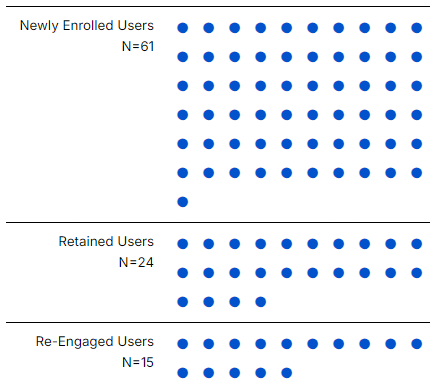
Composition of Q1 2025 MAU Average for LiveWell Normalised to 100 Users
Hacking the MAU numbers
Whether you have read my User Engagement Blueprint or not, it should be clear that it is much easier to acquire new users, or re-engage existing but churned users than it is to retain users month-over-month.
However, because these two comparatively lower effort cohorts make up the overall headline figure, you will often see re-engagement and acquisition efforts happening across many different platforms and businesses just to bolster up the MAU figure so that they look good in standups and quarterly reviews etc
Plus by being aware of this as a consumer, you will actually see this practice across the digital landscape.
So next time you get a “hey, we miss you” email, consider that someone’s MAU target is not being hit.
Alternative Metrics
At LiveWell, in order to bring more transparency we eventually moved away from the MAU figure, giving preference instead for a metric of MAU excluding New Users.
Of course you end up taking a hit on the headline, but that’s where real growth shines through and if you measure the right thing, then you will also know exactly what areas of your business and platform to target.
If you want to understand where to focus your development efforts in order to grow your monthly retained users, my User Engagement Blueprint provides exactly a structured approach to analysing and understanding user metrics.
Get started now - get The User Engagement Blueprint for free